
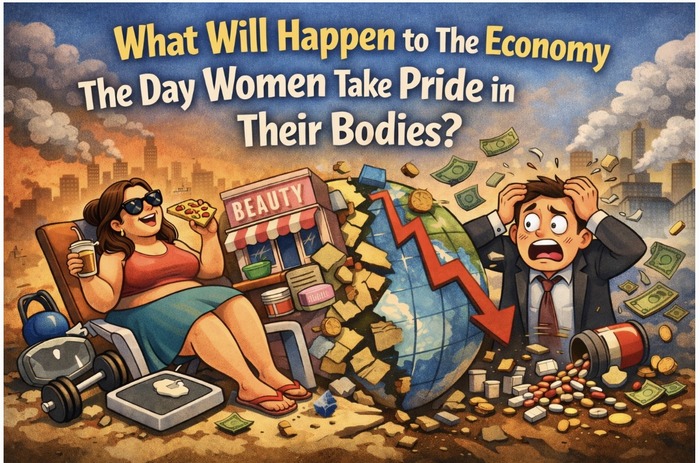
….So, will the global economy collapse if women stop comparing themselves to others?
This thought didn’t arrive during deep meditation or an economics lecture. It showed up while I was eating pizza, wondering why the slice was perfect in size but I wasn’t! I said it aloud to my husband, halfway between a bite and a laugh.
He paused, looked at the pizza, then at me and said nothing except, “Why don’t you pen a well-researched article on it?” His nudge clearly meant I was onto something. That’s when I realised: if women ever stopped questioning their bodies, the economy might need therapy!
Did You Know Your Confidence Is a Trade-able Commodity
You’ve heard of oil futures and data futures. But nobody ever models confidence futures — until now. Try thinking of an alternate financial universe where women don’t wake up feeling they need one more cream, gadget, or “lean look” to feel adequate. What would happen?
Answer: A bunch of industries ! The ones that thrive on aspiration, comparison and perceived imperfection , would feel like their spreadsheets just lost a decimal point.
Because, let’s be honest: somewhere deep in the DNA of global capitalism hides an unspoken assumption because…insecurity is good for business.
Beauty’s Billion-Dollar Backbone – Hint, It’s You
Let’s start with the numbers that make even economists blink.
The global beauty and wellness products market (that’s makeup, skincare, supplements, body serums, wellness concoctions and every “solution” in between) is projected to hit $3.3 trillion by 2032 with a CAGR around 8.6% from 2025 to 2032.
The beauty and wellness market more broadly is expected to grow even faster, by some estimates reaching nearly $4 trillion by 2035 at around 8% CAGR.
That’s not toddler-pushing-a-piggy-bank Maths. That’s trillions of dollars built on people believing that they will get one more product, one more plan, one more tweak away from something better*.
In other words: If women suddenly felt perfect as they woke up to simply a healthy routine, no dieting tweak, no transformation, half the market’s growth spreadsheets might spontaneously combust!
Wellness Isn’t Just Sexy Yoga Pants ! It’s a Trillion-Dollar Sector
Here’s a fun twist: the term wellness used to mean “not unhealthy.” Now it means ongoing maintenance with a side of guilt if you skip leg day. And the planet has leaned in….hard.
The global health and wellness market has been encompassing everything from skincare to supplements to mindfulness apps! It was recently valued at about $6.57 trillion and could surpass $11 trillion by 2034, growing at a CAGR of around 5.4%.
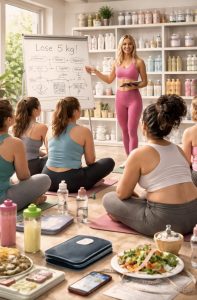
So, billions of humans have turned being alive into a subscription model:
-
App notifications that say “watch this 2-minute stretch!”
-
Weekly vitamins with names that sound like techno music
-
Meditation that feels like a to-do list you forgot to check off
What would happen if women woke up and decide “Nope, today I won’t fix myself, unless I feel unwell”?
Well, whole corners of the economy might have to pivot from solutions to satisfaction. And that’s a terrifying projection model for a market that thrives when people feel just a bit short of perfect.
After facing a somewhat toxic work culture in the media, where the focus was more on women’s bodies than at work (even when a woman is behind the camera!)…I also gained confidence, when I joined Yoga Classes under Neetu Jain’s Fit & Shine Yoga Studio…but mind it not for weight-loss, but to gain back body and mind strength. The strength that we all have, but perhaps we need to be shaken up, woken up! Neetu did that…and keeps doing it for all her students (from children to 70+ in age). But then, how many Yoga Teachers/ Fitness Teachers are actually Gurus? Just Asking?
The Injectable Shortcut Era When Patience Lost to Prescription
Every era has its miracle solution. Some had green juices. Some had aerobics tapes. Ours has an injectable OZEMPIC! Supposedly, it quietly exited the pharmacy aisle and entered everyday conversation — often whispered, sometimes joked about and frequently misunderstood.
Ozempic — specifically the class of GLP-1 receptor agonist medications (used clinically for diabetes and weight management) is more harming than it seems! Originally designed for metabolic health, this drug didn’t become famous because of science. It went viral because it promised something modern society worships: SPEED!
Why wait months when results can arrive before the next social event? Suddenly, weight loss was no longer a journey! It was logistics.
This moment says less about medicine and more about us. A culture so conditioned to compare bodies that even patience began to feel inefficient. When timelines accelerated on screens, expectations followed. The body, apparently, was expected to update faster too.
From an economic lens, this wasn’t disruption. It was demand meeting desperation. Entire markets perked up. Conversations shifted. And once again, the body became a spreadsheet where “faster” looked better than “healthier,” and “now” beat “sustainable.”
The humour, if there is any, lies here: We live in a world that struggles to wait 30 seconds for a video to load, yet expects bodies to remain untouched by time.
Surgery and “Fix-It” Services = The CAGR of Confidence Deficits
Beyond lotions and potions, there’s operative optimisation.
The global cosmetic surgery and services market (think procedures and enhancements) was around $97 billion in 2025 and is projected to grow with a 5.5% CAGR through 2030.
That includes everything from non-invasive tweaks to the big ticket structural upgrades. It’s a vivid demonstration of how much we’re willing to invest in ourselves, literally because somewhere we decided “I have to look this way to be valued.”
If women collectively said, “I love my natural self and don’t need a procedure tomorrow,” some portion of that $100 billion could be staring at a recession.
Supplements? Let’s Pay for the Promise, Not the Peace
The market for women’s health and beauty supplements , vitamins and capsules promising “glow,” “balance,” or “the best version of you”…. is also slouching toward the future.
From a value around $57 billion in 2024, it’s expected to hit nearly $77 billion by 2030, growing at around 5.3% CAGR. This is the part of the economy that says:
“Drink this and you’ll be more you.”
Meaning satisfaction has been repackaged as a daily pill — and billions are happy to subscribe.
The Dirty Little Secret- Did You Know Forced Comparison Is a Product?
Here’s where it gets juicy.
No one wakes up thinking: “I wonder how much the total addressable market of face serums is today?”
Nope.
What happens instead is:
-
A scroll here,
-
A swipe there,
-
An ad mid-scroll that says, “You deserve this better version of you”.
Social media has turned self-image into a real-time feedback loop that also happens to be the marketing funnel for every industry above. When women see heavily curated images, tightly cropped narratives, 15-second routines promising “your best skin ever”, something inside says:
Maybe I need this too.
Algorithms don’t ask permission; they ask engagement and insecurity generates helluva engagement.
This isn’t mean, it’s mechanistic. And it is one of the most powerful economic forces most models still don’t properly account for.
Now imagine the unthinkable: What If Women Just… Didn’t Care?

Women wake up. They don’t filter. They don’t compare. They don’t chase the perfect look because they decide, collectively and with joyful conviction, that their bodies are not problems to be solved.
Let’s break down the economic ripple effects:
Beauty & Wellness Products: With a projected multi-trillion dollar growth path (8%+ CAGR), this sector relies on incremental desire. If desire flattens? Growth curves plummet.
Cosmetic Procedures: A $97+ billion pipeline feeding off aspiration and comparison slows.
Supplements & Daily Fixes: A $77 billion segment based on “better living through chemistry” fizzles if self-esteem rises.
Mindfulness Apps & Daily Rituals: If women decide their unfiltered selves are enough, entire empires built on self-improvement anxiety have to rethink strategy.
The joke, if it can even be called that, is that these industries function best when perfection seems just out of reach. Remove that illusion and growth projections everywhere suddenly look a lot less… exponential.
Satire, but Also a Mirror
This isn’t a riot against beauty or self-care. It’s a light on something real:
The global economy isn’t just oil and semiconductors. It’s aspiration and with aspiration often comes insecurity.
Women have been told to compare upward, to chase ideals, to see themselves as projects.
And billions said, “Sure — why not?”
Which is great…but for markets, NOT YOU….my dear ladies!
But what if women stopped buying imperfection as an opportunity? Then what?
Economists would have to find new growth engines. Markets built on insecurity might contract. Social pressure economies would need a rethink. And you would have a great mental health, as added bonus!
And perhaps…just perhaps….a next generation might discover that confidence is the only thing that shouldn’t be a product.
JAAGO GRAHAK, JAGO?!! If this made you pause, share it….not to convince anyone! But to start a quieter, braver conversation about how comparison became a business… and confidence became optional.