
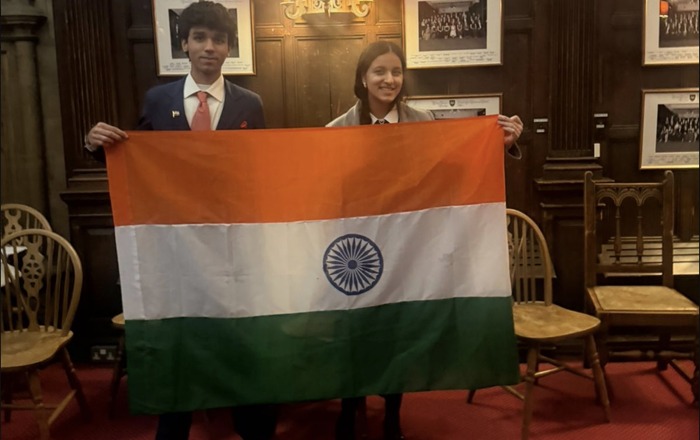
From participating in his first debate barely months ago to representing India at the prestigious Oxford Union, Grade 12 student Angad Singh of Step By Step School, Noida has scripted a remarkable rise in the global debating circuit. Alongside teammate Aarna Dhingra, Angad emerged among the top three school debating teams from India. They were competing against over 220 teams nationwide.
At the Oxford Schools’ Debating Competition 2025-26, the duo achieved a historic performance. They finished joint 17th among nearly 130 elite school teams representing 45 countries worldwide. Notably, they ranked above legendary British institutions like Eton College and Harrow School. They also emerged as the highest-ranked Indian team at the tournament.
In this Visionary Voices conversation with The Think Pot…. Angad Singh opens up about his rapid journey into debating, preparation methods, confidence-building, balancing academics with international competition. That all, along with what it truly feels like carrying the Indian flag into one of the world’s most iconic debating chambers.

You entered debating only last year and are now among the top-ranked school debaters representing India globally. Looking back, what changed most in your mindset during this journey?
I think the biggest change in me was realising that good debaters aren’t simply born great speakers. When I started, I genuinely believed that some people were just naturally articulate and fearless. And I just wasn’t one of them. So, I would worry about stuttering, going blank or not knowing what to say. Thus, I convinced myself that maybe I just wasn’t made for debating. And that I shouldn’t even bother to take this seriously going forward.
But over time, that completely changed. Because I realised that confidence isn’t something you’re born with – it’s something that you build through preparation. The more you practice, research, understand the techniques of competitive debating and develop a broad understanding of different ideas and issues – the more naturally you start trusting yourself when the time comes.
And that shift changed everything for me. Because, instead of asking myself, “What if I can’t do this? I probably can’t anyway”, I started thinking, “Why can’t I?” – That if I am willing to focus and put in the work, learn the skills and prepare properly, then there’s no reason why I can’t compete with and beat anyone.
I stopped internally setting my limits before I even fully started. And with passing time, debating became a lot less intimidating and a lot more exciting. See everything’s more exciting when you win, isn’t it?
Before debating officially, were you always someone who enjoyed discussions and arguments? Or did this confidence develop later during school competitions?
I have always enjoyed discussions and questioning things, but I definitely wasn’t an outspoken student like people might imagine. In fact, I was always the quietest person in class. I was extremely shy and absolutely terrified of public speaking or presenting in front of an audience. Even today, I still get quite nervous in front of a crowd – just a lot less than I used to.
At the same time, I have always loved following current affairs, politics and general knowledge. I have always had plenty of opinions and standpoints, many of them quite unconventional. Although I rarely ever expressed them outward. My only real debating experience growing up was probably arguing with my parents over everything imaginable! Or while trying to negotiate my way out of something at home!! (Angad chuckles)
What debating gave me wasn’t a bundle of new personal views. It became a platform to express all that I thought and deepen my understanding of them.
It gave me a place where everyone’s curiosity was encouraged, disagreement was productive. In fact, it was the aim and having a well-reasoned opinion was actually valued. The more I competed, the more comfortable I became speaking under pressure. Comfort grew while speaking to crowds that I had never imagined myself in front of. My interest in debating ideas only grew deeper. Looking back, I do think debating made me somewhat more opinionated. But then, more importantly – it gave a voice to the thoughts. The thoughts that had always been there but had never really been expressed.
Winning your very first school debate is extraordinary. How did you prepare for it and did you realize then that debating could become something much bigger?
To be completely honest, I knew almost nothing about debating before that competition. I hadn’t watched any debate rounds, attended any workshops or done any formal training. Most of what I knew came from reading online and asking ChatGPT all my questions about how debates worked. I wrote a speech, kept editing and rewriting it. I practiced it out loud a few times and just hoped for the best.
I was incredibly nervous going into the competition. My goal wasn’t to win, that seemed unattainable, but it was simply to try something new and have fun. Even after giving my speech, I thought I had done reasonably well, but winning had never even crossed my mind. That’s why I was absolutely shocked when my team won! And I was named the Joint Best Speaker of the competition! I genuinely couldn’t believe what had just happened.
More than anything, that experience gave me confidence. It made me think that if this was what I could achieve on my very first attempt, then maybe there was something worth pursuing here. And so I did; and my journey began.
I actually found one of those old speeches recently. Looking at it now, it’s honestly not very good at all. But that’s what makes it special. It’s a reminder of just how much I have learnt. And how far I have come in a relatively short time.
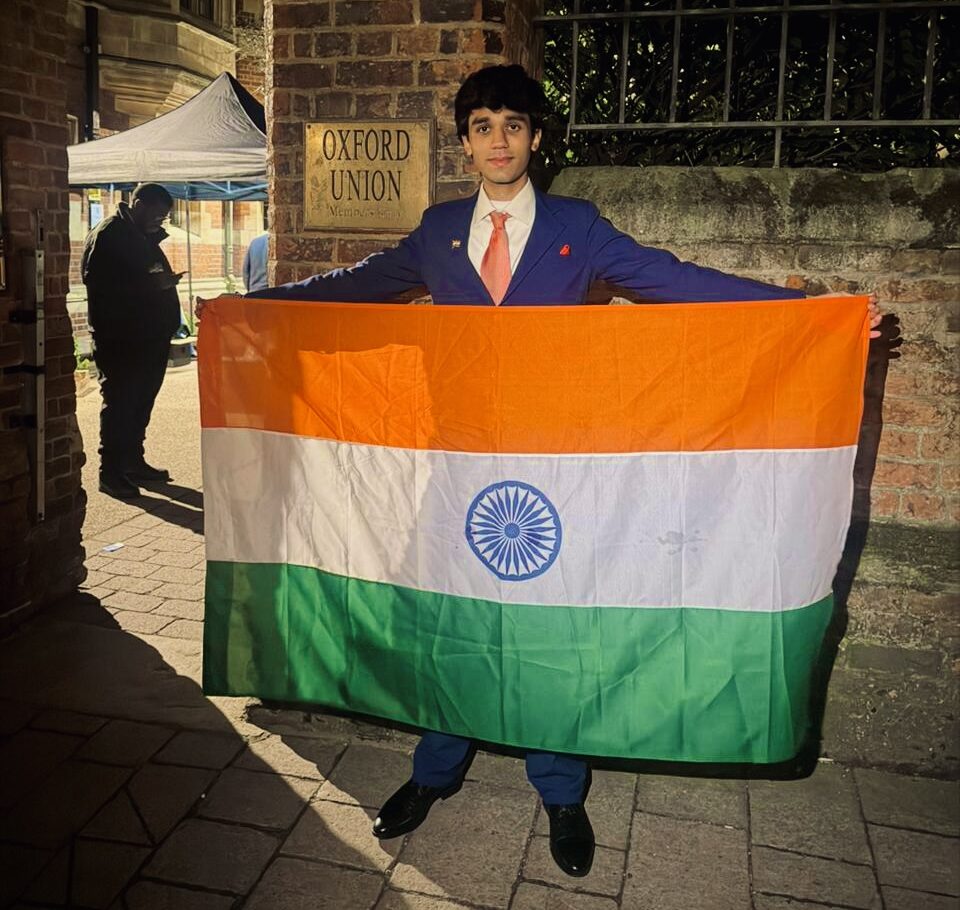
Finishing above institutions like Eton College and Harrow School at an international competition is a huge achievement. What was your immediate reaction after seeing the final rankings?
Honestly, my immediate reaction was complete disbelief. After the final preliminary round, I felt I had performed quite poorly. I was worried that I might have cost us a strong finish. As the results ceremony began in the Oxford Union hall, teams started being announced one by one. When our name wasn’t called early on, we gradually convinced ourselves that we probably hadn’t done as well as we’d hoped.
Then, completely out of nowhere, our team was announced as finalists in the ‘English as a Second Language’ category! That put us in the top 20 ranks overall. I genuinely couldn’t believe it. I remember panicking, literally shaking and smiling uncontrollably at the same time. It was one of those moments that doesn’t feel real when it’s happening.
What made it special wasn’t really finding out which schools we had finished above. But it was the realisation that we had exceeded not just our own expectations, but also that of almost everyone around us. That too on the biggest stage either of us had ever competed on. That was the moment it truly sank in that we belonged there.
The Oxford Union has hosted personalities like Albert Einstein, Winston Churchill and Shashi Tharoor. What emotions did you experience while debating on that same stage?
I had definitely heard of the Oxford Union long before I ever imagined speaking there. I knew about its incredible reputation in the debating world. After being selected to represent India, I started reading more about its history and the extensive list of remarkable people who had stood on that very stage.
The thought that I had actually earned the opportunity to speak in the same chamber as them was genuinely hard to process. I still remember walking into the chamber for the first time and pausing to let the moment sink in! I would see it so many times in videos online and suddenly I was actually there. For a few seconds, I had completely forgotten the reason I was even there. I was so amazed by the history and grandeur of the place that I was standing in. If anything, it made me even more nervous.
But what stayed with me most was the realisation that I wasn’t just debating for my school and in my city, anymore. I was representing India. We were competing against students from all over the world on one of the most prestigious debating stages there is.
Even in between the rounds and sometimes right after I would finish speaking, it would suddenly hit me again: “I am actually here.” It was intimidating, exciting, surreal and incredibly motivating all at once. It’s a feeling that I’ll never forget.
What does preparation for a world-class debate actually look like behind the scenes: research, mock rounds, current affairs reading, teamwork or spontaneous speaking practice?
I think people imagine that preparing for a major debating tournament means spending hours every day practising speeches. For me, it wasn’t really like that at all. Instead, passive improvement of my debating skills gradually became part of my everyday life. I would keep up with current affairs, watch international debate rounds online and spend time exploring different issues whenever I could.
One resource that genuinely helped me actually was OpenAI tool ChatGPT. I would use it to learn new debating techniques, explore unfamiliar topics and even find small debating drills that I could practice on my own. I also wrote a few practice cases, rehearsed them out loud and took every opportunity to learn from mock rounds and judges’ feedback.
Interestingly, Aarna and I only did one mock debate together between being selected in January and competing at Oxford in March. Even so, our styles complemented each other naturally. She was brilliant at extending our case and rebutting the opposition, while I usually focused more on introducing and developing our main arguments.
If I had to give one piece of advice, it would actually be to watch great-quality debates online. Simply observing how the world’s best school debaters think, structure arguments and respond under pressure taught me far more than I ever expected.
Debate competitions often demand quick thinking under pressure. How do you personally handle nervousness, unexpected arguments or difficult rebuttals during live rounds?
The honest answer is that I still get nervous before almost every debate. Right before I am about to speak, I usually just have some water, close my eyes, take a few deep breaths and try to settle my nerves. But something interesting happens once I begin speaking. After the first few sentences, I usually find myself in a sort of flow state where I stop thinking about the audience or the pressure and just focus on my thoughts themselves. That’s probably my favourite part of debating!
Whenever I have enough preparation time, I try to think of every major argument the other team could possibly make and then prepare responses for each of them beforehand, so I am rarely caught completely off guard. Of course, in impromptu debates, that’s not always possible. So, if it’s a topic I am genuinely interested in and know well, then rebuttals usually come to me quite naturally because they are built on knowledge, experience and instinct. But if it’s about an unfamiliar topic, I still sometimes blank out and that’s something I am continuing to work on. I think debating has taught me that staying calm is far more important than having the perfect answer to everything.
How difficult is it to balance Grade 12 academics, competitive debating, travel and personal life, especially during such a crucial academic year?
Balancing academics, debating, travel and my personal life definitely hasn’t been easy and I don’t think I have always managed it perfectly. Preparing for Oxford, travelling there and missing the first week of Grade 12 inevitably created a backlog in school that took quite a while to catch up on. I also sacrificed quite a bit of sleep and free time along the way.
Academically, there was a small cost too. My Grade 11 final examination average was around 85%, which was about five percentage points lower than my Grade 11 midterm average. I do think debating played a part in that. But it was a trade-off that I consciously chose to make because, in my view, debating helps me develop invaluable skills that are directly relevant to the career I want to pursue in law. I am learning critical thinking and public speaking as well as analysis….and even communication and persuasion under pressure. More importantly, it’s something I genuinely love doing.
I am currently in Grade 12, so my board examinations are still ahead of me and more crucially, entrance exams for law universities. Looking back, I have realised that balance isn’t about giving everything equal time every day – but it’s about knowing what deserves your attention at different points in your journey, compartmentalising and then fully committing to whatever you do.

Amid changing political times, many Indian students hesitate to speak publicly despite having strong opinions. Why do you think debating and communication skills are becoming increasingly important today?
I think debating and communication skills are becoming more important than ever because we’re living in a time where it’s incredibly easy to form opinions quickly. We see headlines, short videos or social media posts and it’s very tempting to accept the popular view without really taking a deep dive into the issue ourselves. Debating encourages you to slow down, ask questions, reason deeply and think critically instead of reacting emotionally.
One of the biggest lessons debating has taught me is that understanding an opinion doesn’t mean agreeing with it. In fact, you’re often required to argue for perspectives you may not personally hold. That forces you to explore different sides of an issue, understand why people think the way they do and then form your own views based on practical reasoning rather than assumptions and superficial thinking. It’s also taught me that changing your mind after hearing a better argument is a massive strength and not a weakness.
Personally, debating has completely changed the way I disagree with people. I am much more comfortable expressing my views. But I am also much more open to having them challenged. Beyond that, debating develops skills like critical thinking, public speaking, research, teamwork, active listening and decision-making under pressure. Those aren’t just debating skills, they are life skills that are valuable whether you want to become a lawyer, businessman, politician, scientist, teacher or anything else.
Carrying the Indian flag at an international debating championship is symbolic. After this experience, what message would you like young Indians to take away from your journey?
If there’s one message I would like young Indians to take away from my journey, it’s that you should never let inexperience convince you that you don’t belong somewhere. Just a few months before representing India at Oxford, I was taking part in my very first debate and wondering whether I was even cut out for public speaking. Looking back now, I realise that the biggest barriers weren’t the competition or the stage, but the limits I had internally placed on myself.
We often comfort ourselves with an altered reality in which we believe that we’re more limited than we actually are. We hear phrases like “nothing is impossible” and dismiss them as motivational clichés. But I think there’s an important truth behind them. The only boundaries we are truly bound by are the ones we choose to accept. We often treat our potential like a fixed ceiling, when it’s actually a horizon. The further you walk, the more it expands.
I would encourage every young person to step outside their comfort zone and walk. Try things that genuinely excite them, even if they are scared of failing or think that they are “not the kind of person” who would succeed. You never know where one opportunity can lead, provided that you’re willing to persist, persevere, stay patient, adapt, remain consistent and keep learning from every experience along the way. That too, all while confidently, but humbly, smiling and believing.
Representing India was an incredible honour, but more than anything, it reminded me that extraordinary opportunities often begin with imperfect starts. A journey of a thousand miles begins with a single step.
Don’t wait for the perfect conditions to start – those will never come. The perfect condition is simply, to start.
Disclaimer: The opinions expressed in the above interview are the personal opinions of the protagonist/protagonists for which The Think Pot is not liable in any manner. To share your views on an apolitical and intense subject like this you can reach out to us at Our Linkedin Inbox.